

Helping Kids Listen: Getting Kids to do Chores with Learning Styles
 Reading Time: 5 minutes
 Turn Chore Time into Confidence Time by Matching Your Child’s Learning Style
Let’s be honest: getting kids to do chores can feel like trying to nail Jell-O to the wall.
You ask nicely.
You repeat yourself.
You maybe even nag. (I hate myself at this stage!)
And still… the shoes are in the middle of the floor, the toys are scattered, and the dishwasher is definitely not unloaded.
Sound familiar?
I’ve been there too—not just as a parent, but as a teacher.
With my younger son, I was convinced he was just refusing to listen.
Half the things I asked him to do never happened.
I was frustrated.
He was frustrated.
And it felt like we were in a constant battle.
Then came the “aha” moment: it wasn’t that he didn’t want to do chores, he just couldn’t process my verbal instructions.
Once I started writing things on a whiteboard instead of saying them over and over—magic. (visualize the wand and hear the “ta-da”)!
Not only did he do everything, he loved the act of erasing each task when it was complete.
That’s when it hit me: Every child processes information a little differently.
And when it comes to getting kids to do chores, how we ask matters just as much as what we ask.
Kids need chores given to them in a way they can actually understand.
Enter: learning styles.
When we match how we ask with how our kids learn, chores stop being a fight and start becoming a skill-building win.
Let’s break this down.
1. What Are Learning Styles, Anyway?
Every child has a natural way they soak up information best.
Some kids need to see it, some need to hear it, and some need to move their bodies to really get it.
- Visual learners need to look at charts, lists, or pictures.
- Auditory learners need to hear it—through words, conversations, or songs.
- Kinesthetic learners need to do it—hands-on, active, interactive.
Sure, most kids use a mix, but usually one style shines through.
And when we tap into that?
Suddenly, the shoes get put away without 17 reminders.
2. Visual Learners: Seeing is Believing
Visual kids thrive when things are right in front of their eyes.
Tell them “Go clean your room,” and they’ll stare at you blankly.
Show them a checklist, and they’ll get moving.
How to Help Visual Kids with Chores
- Chore charts: Old-school but golden. Bonus points for stickers, colors, or fun icons.
- Whiteboards or lists: Write out their tasks for the day. The joy of erasing or checking them off is half the motivation.
- Color coding: Red chores for morning, blue chores for evening. Easy peasy.
- Show, don’t just tell: Folding laundry with them once beats five verbal reminders.
💡 Pro tip: Break big chores into small steps. Instead of “Clean your room,” try:
- Put toys in bin.
- Fold blanket.
- Put books on shelf.
It feels doable instead of overwhelming.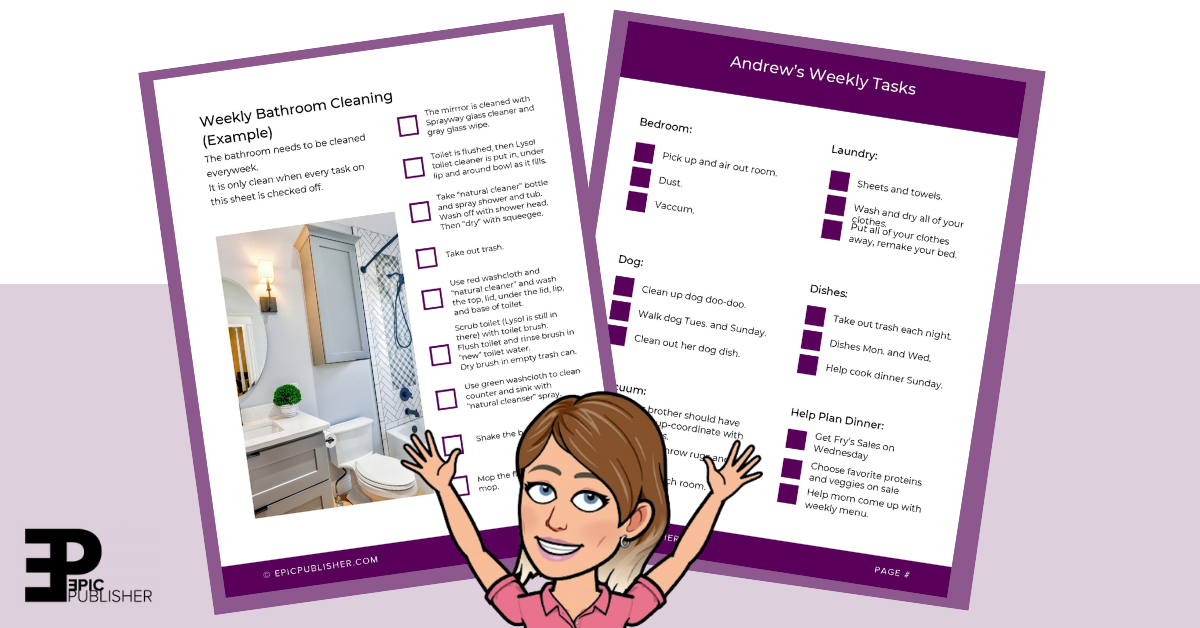
3. Auditory Learners: Talk It Out
*Auditory does not mean, “Whew, I can just tell them and they will ‘get’ it.”
Auditory kids remember songs, conversations, and jingles—but that sticky note on the fridge?
Might as well be invisible.
For them, chores need to come with a soundtrack.
How to Help Auditory Kids with Chores
- Chore songs: Make a silly clean-up song or play their favorite playlist during tidy time. Music sets the rhythm.
- Timers with sound: Alexa reminders, phone alarms, or a dramatic countdown (“3…2…1…Go feed the dog!”).
- Talk it through: Walk them step-by-step while they’re doing it.
- Collaborate: Ask questions like, “Why do you think we need to take out the trash?” They’ll light up when included in the conversation.
💡 Pro tip: Record your own short “chore message” on your phone for them to play back. It feels novel, and you don’t have to repeat yourself. Win-win.
4. Kinesthetic Learners: Hands-On Helpers
Kinesthetic kids are movers and doers.
Sitting still with a list?
Torture.
Give them something physical to do, and they’re all in.
How to Help Kinesthetic Kids with Chores
- Make it a game: “Let’s see who can pick up 15 Legos the fastest.” (Spoiler: they’ll always beat you, but that’s the point.)
- Tools matter: Spray bottles, brooms, laundry baskets—if they can hold it, push it, or carry it, it feels real.
- Chore jars: Write tasks on slips of paper. Let them pull one, complete it, and toss it into a “Done” jar. Movement = satisfaction.
- Delivery missions: Give them a basket of laundry and let them deliver clothes like a mail carrier.
💡 Pro tip: Lean into the “helper” role. Kids this age love responsibility when it feels purposeful. Call them “Captain Table Setter” or “Laundry Hero” and watch them beam.
5. Build a Chore System With Them, Not For Them
Here’s the secret sauce: kids buy in more when they feel like part of the process.
Instead of slapping a chart on the wall and announcing, “Here’s your chores,” let them help design the system.
- Let them pick: “Do you want to sweep today or load the dishwasher?” Choices = empowerment.
- Rotate jobs: Keeps things fresh and fair.
- Celebrate success: High-fives, verbal praise, maybe even a small family celebration when everyone hits their chore goals.
- Keep it collaborative: Ask, “What would make this easier for you?” Their answers might surprise you.
When kids help shape the system, they’re not just “doing chores.” They’re taking ownership. And that’s where independence really blooms.
Wrapping It Up: Chores That Build Confidence
Here’s the truth: chores aren’t just about clean floors or folded laundry.
**Did you “hear” that? Seriously, chores are not about the actual chore…
They’re about teaching kids life skills—responsibility, independence, and confidence.
And when we present chores in ways that match their learning style, everything shifts.
No more constant nagging.
No more frustration. Just kids who know what’s expected, feel capable of following through, and actually take pride in their contribution.
So next time you feel like you’re hitting a wall, ask yourself: Am I giving this chore in my child’s learning language?
Maybe it’s a chart.
Maybe it’s a song.
Maybe it’s a hands-on mission.
Whatever it is, it’s a bridge between you and your child.
And trust me—you’ll love seeing their face light up when they wipe a chore off the board or finish a task all on their own.
Because that’s not just a chore done.
That’s confidence built.
“You listen to me now. You’ve always had the power, my dear, you just had to learn it for yourself.”
— Glinda, The Wizard of Oz